


Company Profile
Guangdong Lihua Mechatronics Co.,Ltd. was found in 2003, it is a manufacturer of high-quality DC motors integrates professional development, production and sales, offering a wide range of DC motors, including brushed and brushless motors, geared motors. We has been at the forefront of motor manufacturing for two decades, consistently delivering high-performing and reliable products to clients worldwide.These motors are designed for various applications, including industrial equipment, medical devices, robotics, automotive systems, motor vehicle and more. We also provides customized solutions to meet specific customer needs.We are committed to minimizing its environmental impact and promoting sustainable practices. The company uses eco-friendly materials and processes in its manufacturing operations and is constantly exploring new ways to reduce its carbon footprint.
Why choose us?
Reliable high quality
We have obtained the IATF16949 , ISO9001,REACH and ROHS certification.And we are aknowledged by 1000+customers . We emphasis on enhancing performance,and controlling quality and keeping our ongoing investment in cutting-edge testing equipment for mini motors.
Custom service & ODM/OEM service
We accept custom motor solution,our professional engineer with expertise can design and create motors tailored to their unique needs.Voltage, speed, torque, driveshaft shape, and length are often free to customize, whereas motor shell diameter and length are fixed parameters.
One-stop solution
As a custom permanent magnet DC (PMDC) motor manufacturer,we can shorten the time for researching ,manufacturing , delivery ,but with high quality mini motor for you.Comparing to other platforms,we can responding more promptly and provide more effective solution for you.
Competitive & favorable price
As a source factory, we can directly give you the most favourable and direct price. From raw materials to finished products, customers can control the whole process and carry out a full range of quality ontrol. And we can promptly and accurately find the problem and improve the programme.

Model: RK-529
Product Category: Micro motor, Carbon brush motor
Out Put: 0.5-10W
Weight: 48g
Application: Boat/Car,/Electric Bicycle/Fan/Home Appliance
Cosmetic instrument/Smart Home

Model: RK-3042 SAG
Product Category: Carbon brush motor
Out Put: 1-50W
Weight: 120g
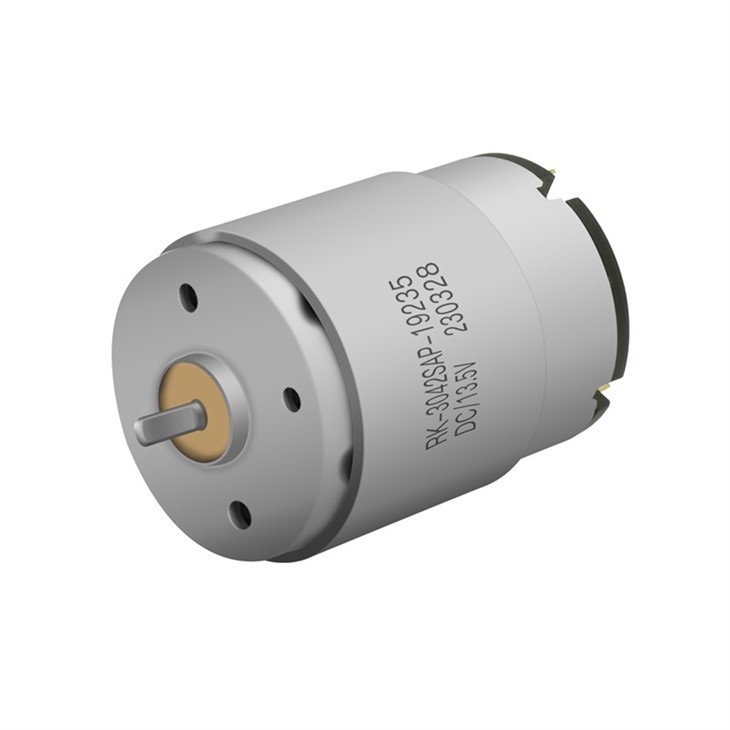
High Torque Carbon Brush Motor
Model: RK-3042SA
Product Category: Carbon brush motor
Out Put: 1-50W
Weight: 120g (Approx)
Application: Pump/Smart toilet/ Smart bathroom/Window-cleaning machine
Wash machine/Mini Water pump/Electrical machine

Model: RK-3030
Product Category: Micro motor, carbon brush motor
Out Put: 0.5-25W
Weight: 37g

Model: RK-2238SD
Product Category: Carbon brush motor
Out Put: 0.5-5W
Weight: 55g
Application:Electrical Machine
Product Notes:
Motor Voltage ,Shaft Length,Top Cover Can Be
Tailor-Made According To Customer's Requirements

Model: RF-500
Product Category: Micro Motor
Out Put: 0.1-4.5W
Weight: 39g(Approx)
Application:
Diffuser/Automatic stirring cup/Commercial Products
Flushing device/Home Appliances/Induction faucet
Induction soap dispenser/Personal Care/Printing machine/Tattoo machine

Model: RK-500
Product Category: Micro motor, DC brushed motor
Out Put: 0.1-4.5W
Weight: 39g

Permanent Magnet Brushed DC Motor
Model: RK-520
Product Category: Micro motor, DC brushed motor
Out Put: 0.5-25W
Weight: 79g
Application:
Actuator /Commercial Products/Industrial Tools
Insecticide /Power transmission elevator/Printing machine
Induction Cooker/Alarm Bell

Mode: RF-520TB
Product Category: Micro motor, DC brushed motor
Out Put: 0.5-25W
Weight: 79g
What is DC Motor M20
A DC motor is powered by direct current, which converts electrical energy into mechanical energy. This mechanical energy causes rotational movement within the motor, helping to power a vast majority of industry applications.
Benefits of DC Motor M20
Higher starting torque
The torque of a DC motor is directly proportional to the armature current, allowing much higher starting torque. This makes them well-suited for applications like conveyors, cranes, locomotives, and other heavy machinery that need high torque for starting heavy loads. The different types of DC motors can provide a wide torque range to match specific requirements.
Precise speed control
DC motors allow easy speed control by varying the voltage/current. This gives precise speed regulation above and below the rated speed. AC induction motors cannot provide the same level of speed controllability. The excellent speed control capability enables adjusting production rates flexibly.
No harmonic effect
The changing flux of AC induction motors induces harmonics – voltages at multiples of supply frequency. This leads to issues like torque pulsations, heating, noise, and lower PF. DC motors do not generate any harmonics, hence no such problems exist.
Fast dynamic response
The speed and direction of a DC motor can be quickly and accurately controlled to start, stop, and reverse as needed. This dynamic response makes them ideal for applications requiring high precision speed regulation. AC motors cannot match this fast torque response.
Lower cost
DC motors are mechanically simple with fewer components than AC motors. This makes them very cost-effective, especially for fractional horsepower ratings under 1 HP. Their simple construction also makes maintenance easy and inexpensive.
Less supporting electronics
DC motors can be connected directly to DC power supplies. But AC motors require inverters/drives for speed control. This reduces the need for extra power electronics with DC motors.
Easy speed regulation
The speed of a DC shunt motor can be easily varied by adjusting the field/armature voltage using a rheostat or potentiometer. This straightforward speed control method is not possible with AC motors.
Types of DC Motor M20
Brushed DC motor
The magnetic field in a brush DC motor is produced by current sent through a commutator and brush that are connected to the rotor. Brushes are made of carbon and can be separately excited or self excited. The stator is the enclosure that contains the components of the motor and contains the magnetic field. The winding of the coil on the rotor can be in a series or parallel to form either a series wound DC motor or shunt wound DC motor.
Separately excited DC motor
In a separately excited DC motor, the motor has separate electrical supplies to the armature winding and field winding, which are electrically separate from each other. The operations of the armature current and field current do not interfere with each other's actions, but the input power is their total sum.
Permanent magnet DC motor
A permanent magnet DC motor has an armature winding but does not have a field winding. The permanent magnet is mounted on the inner surface of the stator core to produce the magnetic field. It has a regular armature consisting of a commutator and brushes.
Self excited DC motor
In self excited DC motors, the field and armature windings are connected and have a single supply source. The connections are parallel or series with parallel made as shunt wound while the series version is series wound.
Brushless DC motor (BLDC)
Brushless DC motors, known as BLDC motors, are a permanent magnet synchronous electric motor driven by direct current and an electronically controlled commutation system, the process of producing rotational torque by changing phase currents. They are also referred to as trapezoidal permanent magnet motors.
Servo DC motor
A servo DC motor has four parts: a DC motor, gearbox, control circuit, and position sensing unit. The gearbox changes high speed input into slower practical speed. The control circuit is an error detector amplifier. The position of the shaft gives feedback to the control circuit and is in a closed loop. With a servo DC motor, if there is any mismatch between the current position of the shaft and its reference position, an error signal is sent to the error detecting amplifier.
How to Choose the Right Gear Motor


Diesel electric locomotives
In a diesel electric locomotive, combustion from the diesel engine is converted into rotational energy by the diesel engine, which is coupled with a generator that converts it to electrical energy. The converted electrical energy is fed to DC motors that are coupled with the wheels on the engine.
Electric vehicles
Brushed DC motors are used in electric vehicles for retracting and positioning electrically powered windows. Since brushed motors tend to wear out rapidly, many electric vehicle applications use brushless motors due to their long life span and noiselessness. Brushless DC motors are used for windshield wipers and CD players. All of the recent hybrid electric vehicles depend on brushless DC motors.
Cranes
In applications with overhauling loads, it is important for the motor to have the ability to hold a full load at zero speed where mechanical brakes may not be required. In those situations, DC motors are the most cost effective and safest option. A major benefit of their use is their size and weight.
Conveyor systems
Conveyor systems require constant speed and high torque, which makes DC motors an ideal option. As has been found with other applications, DC motors have high torque at start up and even consistent speed. Brushless DC motors are the most commonly used for conveyor applications. They are noiseless and can be easily controlled, a major requirement for conveying systems.
Ceiling fans
Ceiling fans made with DC motors have become extremely popular. They use less power and have a rapid start up torque. The alternating current in a home or office is easily converted to DC power by a transformer, an effect that decreases the amount of power required by the fan. As with other DC motor applications, brushless DC motors are most commonly used in ceiling fans.
Pump drives
DC motors have been the main driving force behind pumps for several decades because of their variable speed control, simple control system, high starting torque, and good transient response. For many years, pumping systems depended on brushed DC motors as their primary source of energy. The development of permanent magnet DC motors and brushless DC motors have offered a more beneficial option for pump system operations.
Elevators
In high speed elevators, AC motors are impractical due to their difficulty decelerating and accurately leveling with the floor. These problems are overcome with DC motors because they allow for infinite control of their speed by varying the current supplied to the armature. As with ceiling fans, the operation of a DC motor for elevators depends on changing the incoming AC current to DC current through the use of a transformer.
Components of DC Motor M20
Stator
The stator is the DC motor's stationary component. Its primary function is to serve as the device's solid outer frame and to generate a magnetic field. The stator's various components are described below.
Yoke
The yoke is the outer cover which provides the structural strength to the motor by acting as a frame. It is usually made of any low-reluctance magnetic material such as rolled steel, silicon steel or cast iron.
Poles and pole shoe
The pole is fixed to the yoke of the motor casing with a pole shoe at the other end. Usually made of laminated wrought iron or thin cast steel, the poles produce a magnetic field when excited by the field coil. The pole shoe is only a tiny air gap away from the armature. It is shaped in such a way as to maximize the magnetic flux that passes to the armature.
Field winding
The field winding is the copper wire wound around the pole with the purpose of generating a magnetic field when a direct current is passed through it. Depending on the type of motor, the field winding can be connected in series or in parallel to the armature.
Armature core
The armature core is a drum-like material that is keyed to the motor shaft. It has a large number of slots to hold the armature winding along its periphery. The core is usually made of high permeability and low reluctance material such as silicon steel. It also has holes for air circulation and cooling, and laminated construction to minimize eddy current losses.
Armature winding
The armature windings are crucial for creating the magnetic flux of the rotor. This is where the conversion of electrical energy takes place into mechanical energy. Depending on the operating voltages and current of the motor, the winding is classified as wave winding and lap winding.
Commutator
The commutator is mounted on the motor shaft and connects to the armature windings. It is made of segments of hard-drawn copper insulated from one another with mica. Its function is to convert torque that alternates to unidirectional torque on the armature.
Carbon brushes
Carbon brushes are contact points which touch the commutator. They are held in place by springs and conduct electricity to the armature coils.
How to Maintain DC Motor M20
Maintain cleanliness
Dust, dirt, and debris can wreak havoc on a motor. A clogged ventilation system can lead to overheating, while grime buildup on windings can disrupt electrical flow. Incorporating basic cleaning procedures into routine maintenance can significantly improve motor function and lifespan. Regularly remove dust and debris from the motor housing and ventilation system using a dry cloth or compressed air from a safe distance. For stubborn grime buildup, consider a professional cleaning service.
Tailor lubrication to each individual motor
While some motors are self-lubricating, others rely on periodic lubrication to keep bearings functioning smoothly. But over-lubrication can be just as detrimental as under-lubrication, so consult your motor's manual for specific lubrication instructions, paying close attention to lubricant type and frequency.
Watch for warning signs of motor trouble
Even with proper maintenance, motors can show signs of distress. Abnormal noises like grinding, screeching, or excessive vibration are all indicators of potential bearing problems. Operating temperature is also a factor. A hot motor is a stressed motor. Check for proper ventilation and have it inspected if the motor consistently runs excessively hot. And if your motor is struggling to maintain speed or output, it could be a sign of internal wear or electrical issues.
Track motor performance and trends
Proactively monitor your motor's performance to identify potential issues before they become major problems. Regularly take readings of motor parameters like vibration levels, operating temperature, and current draw. Keep a log of these readings to track trends over time, looking for any significant changes or deviations from normal operating parameters. Investigate any anomalies to identify potential root causes before they lead to a breakdown.
Consider a rewind if performance issues arise
Motors are complex machines, and even with good maintenance, their windings can eventually deteriorate. Rewinding involves meticulously removing the old windings and replacing them with new ones. This can be a cost-effective way to extend the life of your motor, particularly for larger or critical motors. Since rewinding is a specialized skill best left to qualified technicians, factors to consider include:
● Generally, rewinding is more cost-effective for larger or hard-to-replace motors.
● Extensive internal damage might make a rewind impractical.
● If a new motor is available at a comparable cost, rewinding might not be the best option.
Certifications


Our Factory
Our team is composed of passionate and dedicated individuals who are committed to delivering the best possible experience to our clients. Facing trouble we will have a effective communication, work together in a cooperative and productive manner, leveraging each other's strengths and abilities, accept diverse solution and way. In order to provide the high quality service and best solution. We have a complete production system for DC micro motor, it concludes 19 Production lines, Purchasing, R&D, Quality Inspection, Transportation(in short distance in China), Sales departments. Quickly reaction, 100% original manufacture. Thus we have serviced for more than 300+ retailers, many DC motors were sold all round the word factories. And won the high praise from them, keep the long win-win relationship.


FAQ
Hot Tags: dc motor m20, China dc motor m20 manufacturers, suppliers, factory, 12v dc reversible electric gear motor, High Torque Brushed DC Motor, gear motor projects, Gear Motor 70 RPM, Stainless pump motor, Industrial gear motor